What is RFID in retail?
RFID in retail is the use of radio frequency tags to identify products individually and automatically. Each item carries a tag with a unique number that a reader captures without line of sight, so stock is read in bulk rather than scanned one unit at a time.
How is RFID different from a barcode?
A barcode identifies a product type and has to be visible to the scanner, one code at a time. An RFID tag identifies the individual unit, is read by radio rather than by light, and can be captured through packaging and in bulk. Barcodes remain cheaper per unit. What RFID changes is the manual effort behind counting and the error rate that comes with it.
What is the difference between UHF RFID and RAIN RFID?
They describe the same technology. RAIN RFID is the industry name for passive UHF RFID built on the EPC Global Class 1 Gen2 air interface, standardized by ISO/IEC as 18000-63. Retail uses this band because it provides the read range and the bulk reading behavior the application needs.
What equipment does an RFID retail system require?
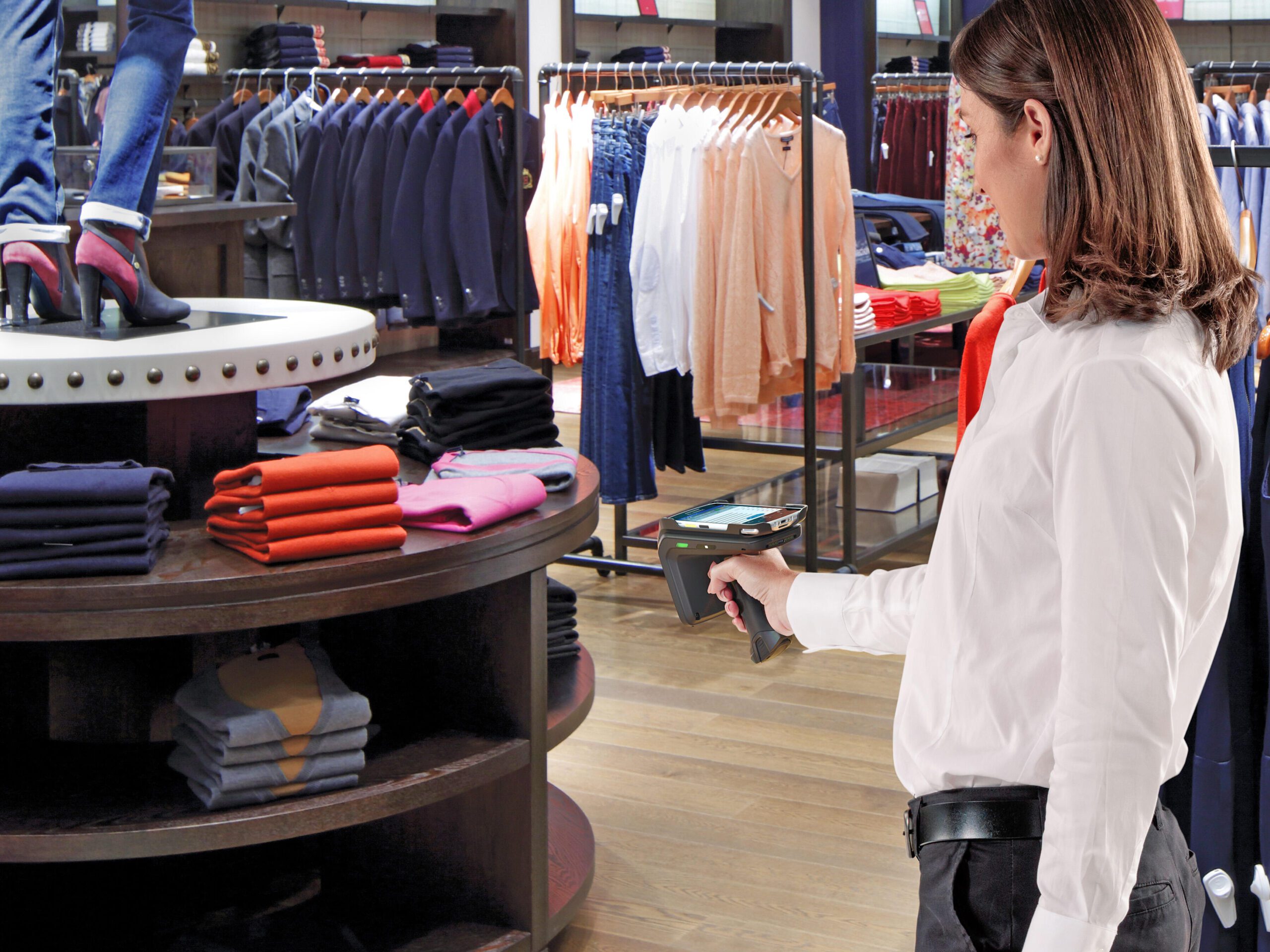
Tags or inlays on the products, readers and antennas matched to each read point, middleware to convert reads into inventory events, and a connection into the system that holds the stock record. In a store this usually means handheld readers for cycle counting, plus fixed readers or portals wherever movement needs to be detected automatically.
Can RFID connect to our existing business systems?
Yes, and the connection is normally made through the middleware rather than directly from the reader. Kyubi System's AIM! middleware manages LLRP compatible readers, applies filtering rules, operates in online and offline mode with persistent local storage, and provides direct integration with ERP and MIS systems.
Does RFID work on metal products and liquids?
It does, with the correct tag. Metal reflects radio signals and liquids absorb them, so both require inlays designed for those conditions, such as on-metal tags for jewellery, tools and electronics. Read performance depends on the product, its packaging and the way items are stored, so tag selection should be validated on the real product before a rollout is committed.
Can RFID be used for anti-theft as well as inventory?
The same UHF tag can carry the inventory identifier and support anti-theft labelling, which avoids applying two separate labels to the same item. Whether an RFID exit solution can replace an existing EAS installation is assessed store by store.
How long does an RFID implementation take?
It depends on the number of sites, on whether tagging is done at source and on the complexity of the systems integration. The usual sequence is to validate tag performance, read points and data flow in a single store or distribution center before committing to a wider rollout.
Which retail categories benefit most from RFID?
Categories with high SKU counts, size or variant matrices, fast rotation or high unit values. Apparel and footwear were among the earliest retail adopters for the first reasons, jewellery and consumer electronics for the last.