Industries / Retail

RFID for Retail

kyubi systems

RFID for retail / Kyubi System

Unit-level inventory visibility, from the warehouse to the point of sale

RFID answers three questions that barcodes cannot answer at scale: what stock exists, where it is and when it last moved. Every item carries a passive UHF RFID tag with a unique identifier, so inventory is read in bulk, without line of sight and without handling products one by one.

01 / The technology

What is RFID in retail and how does it work?

RFID in retail is the use of radio-frequency identification to give every product a machine-readable identity, so that inventory is counted and located automatically instead of being scanned by hand.

The technology used in retail is passive UHF RFID, also known as RAIN RFID. It follows the EPC Global Class 1 Gen2 air interface, standardised by ISO/IEC as 18000-63 and previously designated 18000-6C. Frequency allocation is regional: 865 to 868 MHz in Europe under ETSI regulations, and 902 to 928 MHz in the United States under FCC regulations. Other countries apply their own allocations, which matters for any retailer that needs a single tag and reader specification to work across several markets.

The tag carries no battery. It draws its power from the reader's radio signal and returns its unique identifier, which is why items can be read through packaging instead of being presented one at a time to a scanner.

The four layers / select one

The middleware layer is where most of the distance between a pilot and an operational deployment is concentrated. Without it, RFID produces reads instead of inventory.

02 / Operations

Where RFID changes day-to-day retail operations

Most retail inventory problems share the same underlying cause: the stock file says one thing and the sales floor says another. A barcode only confirms what someone has decided to scan, unit by unit and with line of sight. RFID removes that dependency, and the operational consequences follow from there.

CYCLE COUNTINGCounting during trading hours

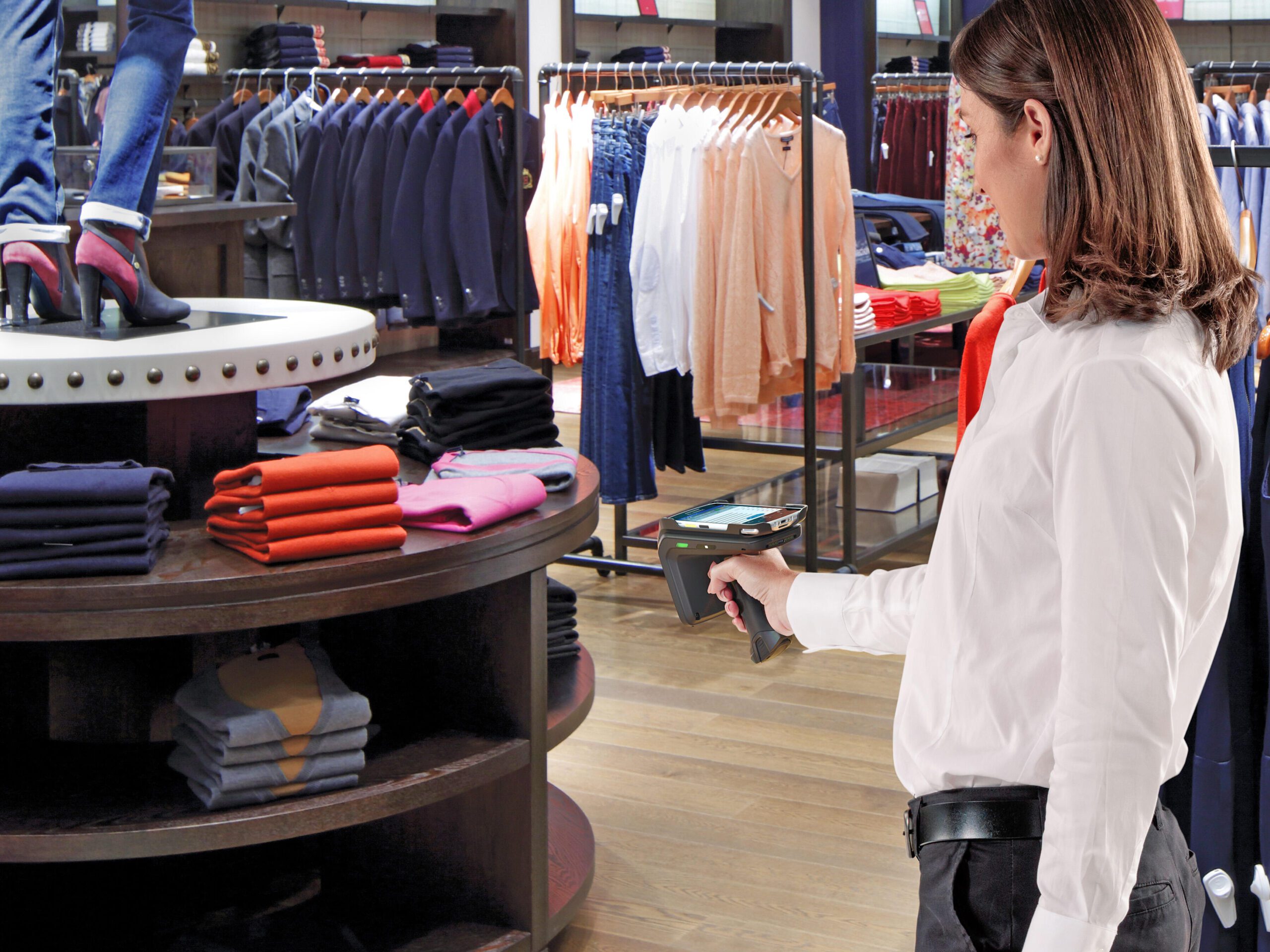
Counting with a handheld reader can be done during trading hours instead of after closing, and repeated often enough for the stock record to stay close to reality instead of drifting between two annual inventories.

GOODS RECEIVINGDiscrepancies caught at the door

Cartons can be verified at the door through a portal or a tunnel, so a discrepancy against the dispatch advice appears on arrival, while the delivery can still be claimed, instead of surfacing later during a count.

AVAILABILITYStock in the building, not on the floor

When the system knows an item exists in the stockroom but has not reached the sales floor, it can raise a replenishment task. Stock that is in the building but not in front of the customer cannot be sold, and does not show up as a stockout in the system either.

OMNICHANNELStore stock the website can rely on

Click and collect and ship-from-store depend on the online channel being able to trust store stock. Unit-level accuracy is the precondition for exposing store inventory on the website without generating cancellations.

RETURNSWhich unit came back

A unique identifier per unit makes it possible to confirm which specific item has come back, when it was sold and in what condition.

LOSS PREVENTIONLosses narrowed down by area and by hour

Comparing what has left the sales floor with what has been sold at the till narrows down where and when losses occur, by area, by product and by time of day, which is what makes them addressable.

The gain is not only making fewer mistakes. It is that replenishment, allocation and markdown decisions stop being taken against a stock file that nobody fully trusts.

03 / Categories

RFID by retail category

The mechanics of RFID are the same across retail. What changes by category is the tag specification, the read environment and the operational problem the retailer wants to solve.

LABEL INLAY / TEXTILE Composition label with an RFID inlay on fabric

RFID for fashion and textiles

Fashion is where retail RFID has the longest track record, and the reasons are structural. SKU counts multiply when size and colour are combined, collections rotate quickly and, on a busy sales floor, a single misplaced garment is practically invisible.

Tagging is normally done at source, on the price ticket or the composition label, so items arrive already encoded and no work is added in store. The commercial argument usually lands on size availability: a store can hold the correct total quantity of a style and still lose sales because the core sizes are not on the floor.

Discover RFID for fashion and textiles
ON-METAL INLAY / REFLECTIVE Fine jewellery, a metallic read environment

RFID for jewellery and accessories

Jewellery imposes two constraints that change the hardware specification. Unit value is high enough to require piece-by-piece control rather than control by style, and the products are metallic, which detunes a standard inlay and reduces read range.

The answer is a tag specified for small, reflective items, built so that the metal surface becomes part of the antenna structure instead of working against it. Performance varies with the size of the piece, the alloy and the way it is stored, so tag selection has to be tested on the real products before any deployment.

Discover RFID for jewellery and accessories
READ IN THE BOX / NO LINE OF SIGHT RFID tag inside a shoe

RFID for footwear

Footwear has a size-matrix problem rather than a volume problem. A single style occupies a long list of SKUs once sizes and widths are counted, most of the stock sits boxed in the back room, and the pair the customer asks for is either found quickly or the sale is lost.

Cardboard does not block UHF signals, so boxed stock can be read without opening the boxes. Applied at box level and at unit level, RFID also makes it possible to verify order picking, so a discrepancy between the order and the pair picked is caught before the order leaves.

Discover RFID for footwear
SERIALISED UNIT / EPC RFID chip on a printed circuit board

RFID for consumer electronics

Consumer electronics combines high unit values with serialised products, which changes what is asked of RFID. The priority is usually unit-level control and movement tracking rather than raw counting speed.

The physics is less forgiving than with textile products. Metal casings reflect the signal, batteries and dense packaging absorb it, and small accessories leave little room for an inlay. Where that work is done, RFID enables serial and batch control and a record of which specific unit was sold.

Discover RFID for consumer electronics

04 / Implementation

What an RFID deployment in retail involves

The following questions determine the cost, the timeline and the operational fit of an RFID programme. All of them are cheaper to resolve before ordering hardware than afterwards.

Kyubi System works through these questions together with retailers as part of its RFID consultancy and implementation work, which covers hardware selection and product testing, the site survey, middleware configuration and the connection to existing business systems.

Request an RFID assessment

Where tagging happens

Source tagging, at the supplier or the manufacturer, is usually the lowest cost per item, because the tag is applied during production instead of being handled again downstream, but it requires coordination with suppliers and an agreed encoding standard.

Which tag for which product

Tag choice follows the material and the shape of the item, not a catalogue reference. Metal, liquids, dense packaging and very small products require specific inlays, tested on the real products in their real packaging.

What the store environment is like

Read zones, metal fixtures, adjoining stores and the physical layout all affect antenna placement and power settings. A site survey is what turns those variables into a specification instead of a surprise during deployment.

How the data reaches existing systems

The integration point with the ERP, the WMS or the POS defines what the project can deliver operationally, and it is the part of the work with the most dependencies outside the RFID system itself.

How staff are going to use it

A counting routine that store teams can complete in the time they actually have is worth more than a technically superior system that nobody runs.

05 / Questions

RFID for retail: frequently asked questions

What is RFID in retail?

RFID in retail is the use of radio-frequency tags to identify products individually and automatically. Every item carries a tag with a unique number that a reader captures without line of sight, so stock is read in bulk instead of being scanned unit by unit.

How does RFID differ from a barcode?

A barcode identifies a product type and has to be visible to the scanner, one at a time. An RFID tag identifies the specific unit, is read by radio rather than by light, and can be captured through packaging and in bulk. Barcodes are still cheaper per unit. What RFID changes is the manual effort behind counting and the error rate that comes with it.

What is the difference between UHF RFID and RAIN RFID?

They describe the same technology. RAIN RFID is the industry name for passive UHF RFID built on the EPC Global Class 1 Gen2 air interface, standardised by ISO/IEC as 18000-63. Retail uses this band because it provides the read range and the bulk-read behaviour the application needs.

What equipment does a retail RFID system need?

Tags or inlays on the products, readers and antennas suited to each read point, middleware to turn reads into inventory events, and a connection to the system that holds the stock record. In store this usually means handheld readers for cycle counting, plus fixed readers or portals wherever movement has to be detected automatically.

Can RFID be connected to our current management systems?

Yes, and the connection is normally made through the middleware, not directly from the reader. Kyubi System's AIM! middleware manages LLRP-compatible readers, applies filtering rules, operates online and offline with persistent local storage and offers direct integration with ERP and MIS systems.

Does RFID work on metal products and liquids?

Yes, with the right tag. Metal reflects radio signals and liquids absorb them, so both require inlays designed for those conditions, such as on-metal tags for jewellery, tools and electronics. Read performance depends on the product, its packaging and the way it is stored, so tag selection must be validated on the real product before committing to a deployment.

Can RFID also be used for loss prevention as well as inventory?

The same UHF tag can carry the inventory identifier and serve for detection at the exit, which avoids applying two different tags to the same item. Detection depends on the width of the exit, the reader and antenna configuration and the orientation of the tag as it passes, and the system has to check every read against sales data to separate a purchased item from an unpaid one. Whether it can replace an existing EAS installation is assessed store by store, not as a general rule.

How long does an RFID implementation take?

It depends on the number of sites, on whether tagging is done at source and on the complexity of the integration with existing systems. The usual sequence is to validate tag performance, read points and data flow in a single store or distribution centre before committing to a wider deployment.

Which retail categories benefit most from RFID?

Categories with high SKU counts, size or variant matrices, fast rotation or high unit values. Fashion and footwear were among the earliest retail adopters for the first reasons; jewellery and consumer electronics for the last.

Contact

Send us your products. We test the tag and show you the read results.

Tag selection, read points and the integration path are decided on real products in their real packaging. That is where an RFID assessment starts.


    Complete traceability from source to point of sale. Batch control, reduction of waste, and compliance with international food regulations.
    Optimize industrial processes with automatic traceability and ERP/MES synchronization. Greater control, security, and efficiency at every stage of production.
    360° logistics control. Automatic identification, reduced loading times, and traceability throughout the supply chain.
    Automated inventory, total stock visibility, and improved omnichannel shopping experience.
    Control of materials, instruments, and textiles with maximum traceability and security. Compliance with hospital and regulatory standards.
    Efficient management of access, accreditations, and cultural assets. Accurate and reliable control of visitors and objects.
    Kyubi System RFID drives traceability in airports and air fleets: predictive maintenance, error-free baggage management, and control of critical materials with total precision.
    Smart asset management and safe maintenance in energy environments. Kyubi System RFID ensures efficiency, traceability, and operational continuity.
    TOP
    kyubi systems
    Privacy Overview

    This website uses cookies so that we can provide you with the best user experience possible. Cookie information is stored in your browser and performs functions such as recognising you when you return to our website and helping our team to understand which sections of the website you find most interesting and useful.

    More information about our Privacy