
Choosing the Right RFID Antenna: A Strategic Guide to Avoiding Costly Mistakes
In the deployment of an RFID ecosystem, the antenna is the component that determines the physical limit of your efficiency.
A high-end reader is useless if the antenna is not capable of accurately “illuminating” tags in a hostile environment.
From Kyubi System engineering, we have seen how a poor technical choice can ruin the ROI of large-scale projects by generating ghost data.
large-scale projects by generating ghost data or blind spots.
For logistics managers and IT managers, the choice is not about aesthetics: it’s a question of applied physics
and cost-effectiveness.
1. Frequency: The basis of communication
Frequency is not just a numerical range; it is the ability of the wave to pass through or bounce off the materials in your inventory.
in your inventory.
UHF (860-960 MHz): This is the standard in retail and logistics because of its long range (up to 12m).
But beware: UHF “hates” metal and water. In environments with high liquid density,
precise tuning is required, which only field experience can provide.
HF and LF: Reserved for short distances and environments where interference immunity is more critical than mass readout speed.
is more critical than mass readout speed.
2. Polarisation: The angle that defines the accuracy
This is the point where most projects fail. Polarisation is the orientation
of the wave’s electric field.
Linear Polarisation: Concentrates all the energy in a single plane.
If your tag is aligned, the range is massive.
It is the ideal solution for conveyor belts where the tag always faces the antenna.
Circular Polarisation: The energy is constantly rotating.
It is essential when the tag orientation is random,
such as in retail self-checkout or palletised goods receiving.
Although you lose some distance, you gain 99.9% reading consistency.
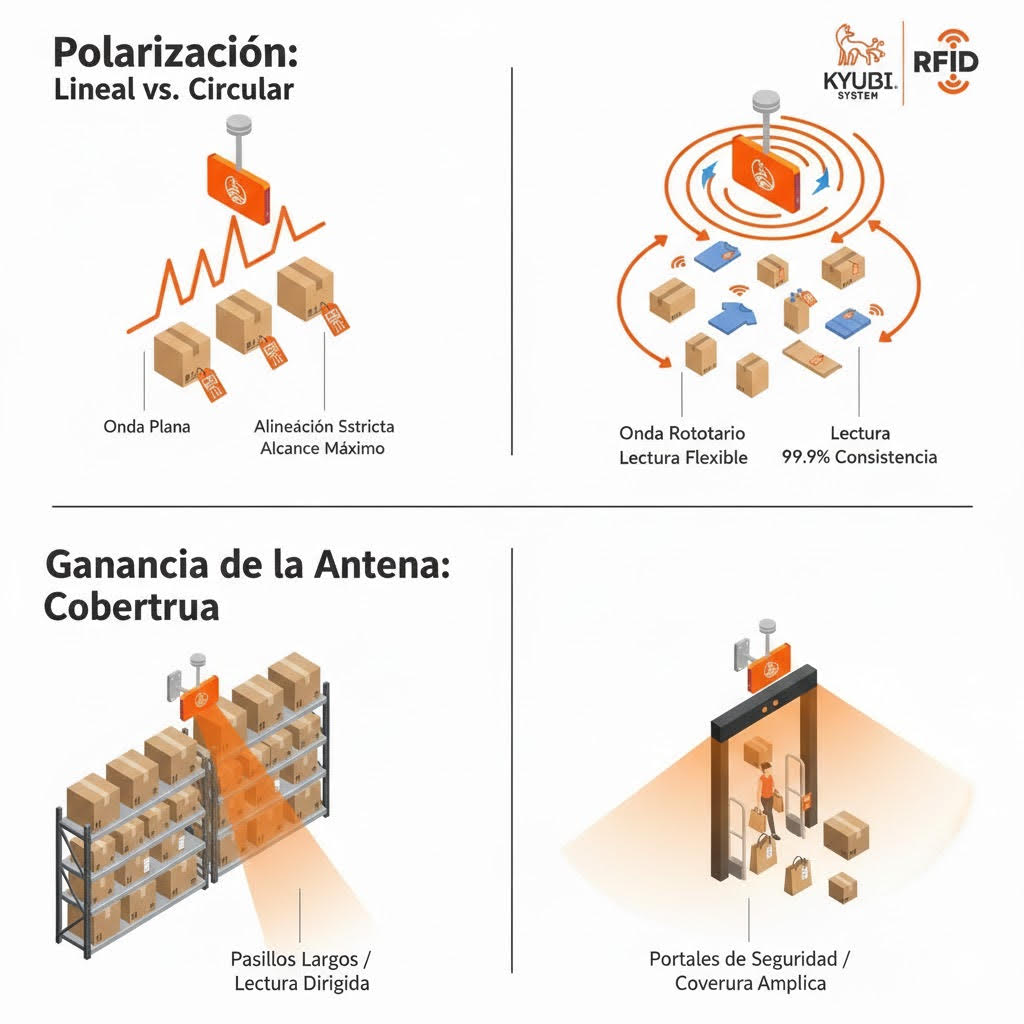
Coverage and gain in RFID environments
3. The trade-off: dBi gain vs. aperture beam
In marketing it is often said that “more is better”, but in RFID engineering, too much gain can be your enemy,
excessive gain can be your enemy.
High Gain (Narrow Focus): Like a powerful torch.
Reaches far but covers little angle.
Use it for warehouse aisles where you don’t want to read the shelf next to you.
Low Gain (Wide Angle): Like a stadium spotlight.
Covers a huge area at close range.
Ideal for security gates and access control points.
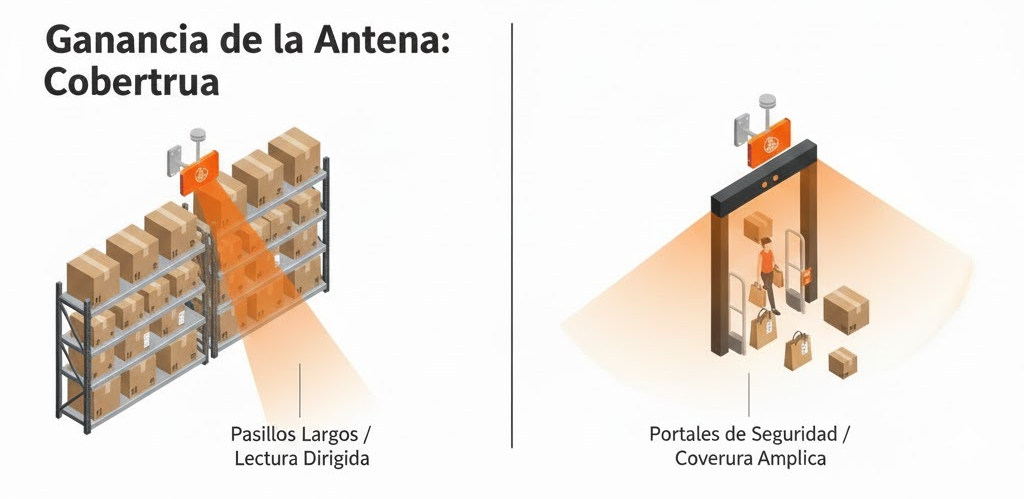
RFID infrastructure in an industrial environment
4. The Kyubi Factor: Resilience and Industrial Connectivity
A technical antenna must not only read well; it must survive.
In our integrations, we audit factors that simulation software ignores:
IP protection: For extreme cold or high humidity environments.
Cabling loss: The use of low loss coaxial cables (LMR-400 or higher) is vital;
a mediocre cable can absorb 50% of your power before it reaches the antenna.
Interference and SWR: We analyse the standing wave ratio to protect the life of your readers.
to protect the lifetime of your readers.
Strategic Conclusion
Choosing the right RFID antenna is a balance between physics, environment and business objectives.
At Kyubi System, we don’t install equipment; we design total visibility solutions
solutions that ensure every tag is counted, every time.
Does your current system have blind spots or erratic readings?
Our engineers can perform a field audit to optimise your radiant infrastructure.