What is RAIN RFID: the global standard for UHF technology that connects billions of objects
RAIN RFID is the open standard for UHF RFID technology that enables the identification, tracking, authentication and interaction with all kinds of items, without contact or line of sight. It is the infrastructure that makes mass traceability possible in our hyper-connected world, and the foundation upon which Kyubi System builds its solutions.
What is RAIN RFID: the global standard for UHF technology that connects billions of objects
RAIN RFID is the open standard for UHF RFID technology that enables the identification, localisation, authentication and interaction with all types of items, without contact or line of sight. It is the infrastructure that enables mass traceability in our hyper-connected world, and the foundation upon which Kyubi System builds its solutions.
UHF RFID technology
GS1 UHF Gen2
ISO/IEC 18000-63
RAIN Alliance
Traceability

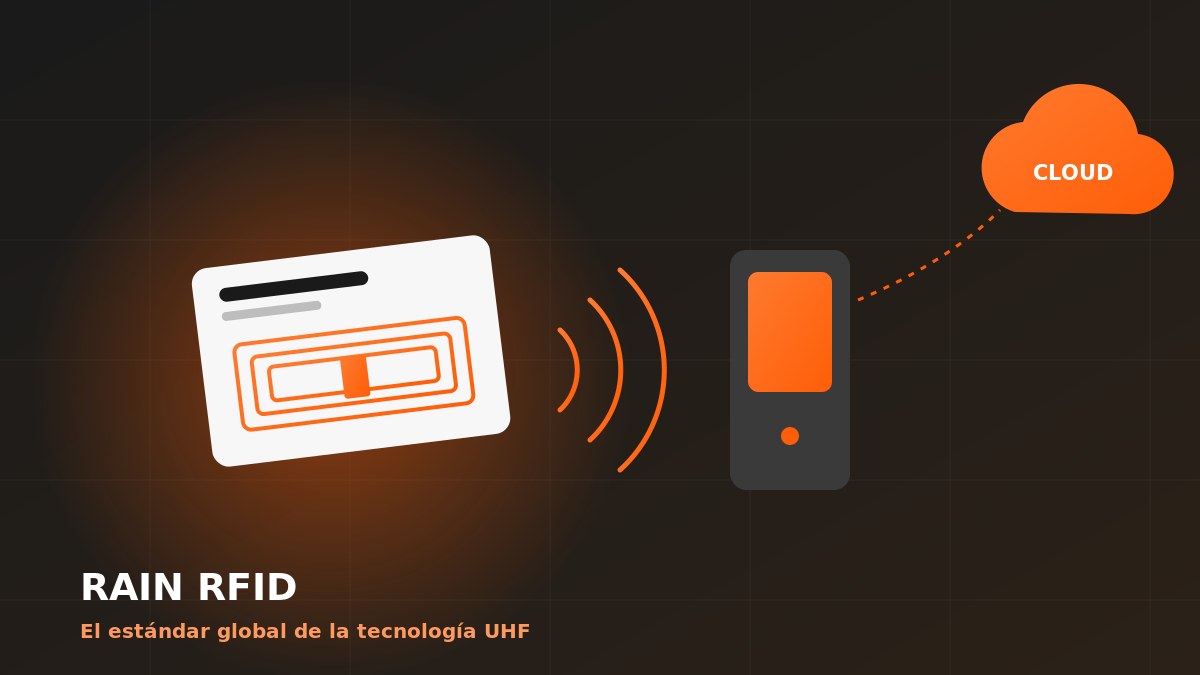
RAIN RFID is the global, open standard for passive Ultra-High Frequency (UHF) RFID technology, based on the GS1 UHF Gen2 protocol, which is internationally standardised as ISO/IEC 18000-63. RAIN is an acronym for RAdio frequency IdentificatioN and also alludes to the link between UHF RFID and the cloud (rain → cloud), where data is stored, managed and shared via the Internet.
For innovative companies, being part of the standards that underpin the industry is a statement of intent. Kyubi System is a member of the RAIN Alliance, the association established to promote the universal adoption of UHF RFID technology. But before we can understand what this membership means, it is worth answering a more fundamental and increasingly frequently asked question: what is RAIN RFID and why has it become the backbone of object identification on a global scale ?
What is RAIN RFID
RAIN RFID is the commercial and industrial name for passive Ultra-High Frequency (UHF) RFID technology operating under the open GS1 UHF Gen2 protocol. In practice, it is the set of rules that enables a battery-free tag — attached to a garment, a box, an asset or a document — to be read by radio frequency, remotely and without line of sight, by any compatible reader worldwide.
Its objective is clear: to enable businesses and consumers to identify, locate, authenticate and interact with all kinds of items. Each tag carries a unique electronic product code that distinguishes it from any other, even from an item that is identical in model, size or colour. It is this digital identity, when read at every point in the supply chain, that feeds into the company’s inventory, traceability and authentication systems.
RAIN RFID is not a manufacturer’s brand, but an open and interoperable standard: a tag from one supplier can be read by another’s reader, just as any Wi-Fi device connects to any router. It is this interoperability that has enabled the deployment of billions of tags worldwide.
RFID, UHF and NFC: understanding frequencies
Under the umbrella of radio-frequency identification (RFID), there are several technologies operating in different bands, and confusing them is one of the most common mistakes made when designing a project. The frequency determines the range, speed and use case.
Low frequency (LF, 125–134 kHz) is used for access control and animal identification, with ranges of just a few centimetres. High frequency (HF, 13.56 MHz) includes NFC, designed for one-to-one interaction with a smartphone at a distance of just a few centimetres. And Ultra-High Frequency (UHF, 860–960 MHz) — the domain of RAIN RFID —enables readings over several metres and of hundreds of items per second, making it the only viable option for logistics, inventory and high-volume industrial traceability.

The standard: GS1 UHF Gen2 and ISO/IEC 18000-63
The strength of RAIN RFID lies in its regulatory foundation. Every RAIN solution is based on the GS1 UHF Gen2 air interface protocol (also known as EPC Gen2), which defines how tags and readers communicate. This same protocol is standardised by the international organisation ISO/IEC under reference 18000-63, which gives it global recognition and validity.
This dual layer — the standard set by GS1, the global authority on product identification, and ISO/IEC certification — is what ensures the ecosystem functions: any certified tag can be read by any certified reader, in any country. The EPC Gen2v2 version also adds advanced security, authentication and anti-counterfeiting features, which are key for applications where data integrity is critical.
A RAIN RFID solution uses a reader to read and write to a tag, manage data and trigger an action, always in accordance with the GS1 UHF Gen2 protocol, standardised by ISO/IEC as 18000-63. The tags are passive: they do not contain a battery and are powered by the energy emitted by the reader itself.
The RAIN Alliance: origins and mission
The RAIN Alliance (originally the RAIN RFID Alliance) was founded in 2014 by four world-leading technology companies: Intel, Google, Impinj and Smartrac. It was founded with a purpose similar to that of other major wireless technology associations — the NFC Forum, the Wi-Fi Alliance and the Bluetooth SIG —: to promote the universal adoption of UHF RFID technology and ensure its interoperability.
Its widespread adoption opens up a world of possibilities in Industry 4.0: connecting billions of items across a wide range of sectors – fashion, retail, healthcare, logistics, automotive and food – using a single language. Today, the alliance brings together manufacturers of chips, tags and readers, as well as system integrators from across the globe, and works closely with GS1 on the evolution of the standard.
Without a common standard, each manufacturer would speak its own language and global traceability would be impossible. The RAIN Alliance plays the same role for UHF RFID as Wi-Fi did for wireless networks: transforming a promising technology into a universal and reliable infrastructure.
How a RAIN RFID solution works
A complete RAIN RFID solution comprises four elements that work in sequence, from the physical object to the cloud where the information is managed:
The tag
A battery-free UHF chip with an antenna that stores the item’s unique code. It can be integrated into a fabric label, a sticker or a durable casing.
The reader
It emits radio waves that activate the tag and receive its response. It can be handheld, fixed, arch-shaped or tunnel-shaped, and reads hundreds of tags per second.
The middleware
It filters, refines and translates the readings into business events, and connects them to the ERP, WMS or traceability platform.
The fourth element is the cloud: the place where RFID-based data is stored, managed and shared via the internet. It is precisely this link between radio frequency and the cloud that gives RAIN its name. The result is a system capable of inventorying, authenticating and tracking assets in real time, without human intervention or line of sight.

Why it matters: benefits and use cases
The adoption of RAIN RFID is driven by a set of advantages that no other identification technology offers all at once. These are the six that have the greatest impact on real-world operations:
Unique identification
Each physical unit is assigned a unique electronic product code, as opposed to a barcode, which only identifies a generic model or SKU.
Line-of-sight-free reading
Tags can be read through boxes, pallets and materials, without the need to orient them or see them, from several metres away.
Mass capture
Hundreds of items scanned per second: complete stock-takes in minutes and validation of entire shipments as they pass through a gate.
Accuracy in excess of 99%
Inventory accuracy jumps from the usual 70–85% achieved with manual counting to over 99%, enabling true omnichannel capability.
Durability and rewritability
Labels that withstand years of use and industrial processes, with rewritable memory subject to permissions.
Secure authentication
EPC Gen2v2 incorporates keys and encryption that make cloning difficult, protecting the brand against counterfeiting.
These features translate into specific use cases: inventory and traceability in retail and fashion, logistics and supply chain, asset management, industrial laundry and workwear, healthcare, the automotive sector and food traceability. In all these areas, RAIN RFID transforms scattered data into continuous, actionable visibility, raising inventory accuracy to over 99%.

Kyubi System, a member of the RAIN Alliance
In line with this shared aspiration amongst innovative companies, Kyubi System is proud to be a member of the RAIN Alliance. For our team, this is a step consistent with the very purpose for which Kyubi was founded: to enable businesses and consumers to identify, locate, authenticate and interact with all kinds of items.
Following years of sustained performance in the sector, Kyubi is part of the association driving the universal adoption of UHF RFID technology under the GS1 UHF Gen2 protocol (ISO/IEC 18000-63). This membership reinforces our position at the forefront of RFID research and technology, and our commitment to creating solutions that take business operations and logistics beyond what is currently imaginable.

RAIN RFID versus other identification technologies
To put RAIN RFID on the technological map, it is worth comparing it with the most widely used alternatives according to the criteria that really matter in an operation:
| Criterion | Barcode | NFC (HF) | RAIN RFID (UHF) |
|---|---|---|---|
| Frequency band | Optical (no radio) | 13.56 MHz | 860–960 MHz |
| Reading range | Direct line of sight | A few centimetres | Up to over 10 metres |
| Line of sight | Required | Not required, but at close range | Not necessary |
| Simultaneous reading | One-to-one (1:1) | One-to-one | Hundreds per second |
| Identification | By model / SKU | Per unit | Per unit (unique code) |
| Ideal use case | Basic point of sale | Consumer interaction | Mass inventory and traceability |
| Global standard | GS1 | ISO 14443 / NFC Forum | GS1 Gen2 / ISO 18000-63 |
It is not a question of choosing one technology and discarding the rest, but rather of assigning each to its specific function. RAIN RFID is the operational infrastructure that handles high volumes; NFC and QR codes form the consumer interaction layer. The most robust solutions combine both.
How Kyubi helps deploy RAIN RFID
Adopting RAIN RFID isn’t just about buying tags: it’s about designing a reliable end-to-end data capture infrastructure. At Kyubi System, we support you throughout the entire process:
Audit and diagnosis
We analyse goods flows and systems (ERP, WMS, PLM) to identify where data capture is failing or inefficient.
Optimised hardware
We select Gen2-certified chips, tags and readers based on the material, environment and specific requirements of each case.
Infrastructure and integration
We design portals, tunnels and reading arches, and connect the hardware to the management and traceability software.
Future trends
RAIN RFID is moving towards passive sensors capable of recording temperature or humidity without a battery, towards chips with greater sensitivity and memory capacity, and towards convergence with NFC within a single package, so that a single tag can be used for both large-scale logistics operations and consumer interaction via their smartphone. The combination of greater range, lower cost per tag and global interoperability will continue to expand its presence across an increasingly diverse range of sectors.
Conclusion
To answer the question ‘What is RAIN RFID?’ is, at its core, to describe the silent infrastructure that is connecting the physical world with the digital one: an open, interoperable and certified standard that assigns a unique identity to billions of objects and enables them to be read contactlessly, without line of sight and at high speed. It is not a passing technological fad, but the foundation upon which accurate inventory, continuous traceability and product authentication at scale are built.
As a member of the RAIN Alliance, Kyubi System is at the forefront of this development, helping organisations to turn the standard into real, measurable and cost-effective solutions.
Frequently Asked Questions about RAIN RFID
What is RAIN RFID?
What is the difference between RAIN RFID and NFC?
What standard is RAIN RFID based on?
Who founded the RAIN Alliance and when?
What is RAIN RFID used for?
What is the read range of RAIN RFID?
Do RAIN RFID tags require a battery?
Is Kyubi System a member of the RAIN Alliance?
Would you like to deploy RAIN RFID in your operations?
As a member of the RAIN Alliance, at Kyubi System we design end-to-end UHF RFID technology solutions: tags, readers, infrastructure and integration for true traceability and inventory accuracy of over 99 per cent.
UHF RFID technology
UHF RFID
what is RFID
GS1 UHF Gen2
ISO 18000-63
RAIN Alliance
RFID traceability
RFID solutions
EPC Gen2v2