

RFID: What it is, how it works and how to implement RFID systems (Complete Guide)
This guide is designed for Operations, Logistics, IT and Digital Transformation managers who need to move from “understanding RFID” to implementing a reliable system that impacts productivity, accuracy and ROI.
Author: Kyubi System
Updated: 2026-03-05
Reading time: 18-25 min
Do you want to validate a use case in your operation?
Recommended proposal: RF + PoC diagnostics with critical reading points (receipt, dispatch, inventory or WIP).
What is RFID
RFID (Radio Frequency Identification) is an automatic identification technology that uses radio waves to read and record electronic tags associated with products, assets or containers. Unlike barcodes, RFID does not require line of sight and allows mass reading (multiple tags at the same instant).
Operational example: a pallet with 200 tagged units can be verified in seconds when passing through an RFID portal or a mass-reading tunnel, generating an automatic “receive” or “dispatch” event in the WMS/ERP.
How RFID works
The basic flow is: the reader emits radio frequency through antennas, the tag responds with its identifier (e.g. an EPC), and the software interprets those readings as business events (receipt, location, check-in, check-out, inventory, WIP).
Flow: RFID readers → Antennas → RF signal → Tags → Response → Middleware/Software → ERP/WMS/MES
What decides actual performance
Environment: metal, liquids, shielding, interference.
RF design: antenna location/angle, polarisation, power, read zones.
Software rules: duplicate filtering, reading windows, order/order/batch validation.
Components: tags, readers, antennas and software.
RFID tags (tags)
A tag integrates microchip + antenna. In industrial and logistics projects, passive UHF RFID is normally used for cost and scalability. For complex environments there are special tags (on-metal, high temperature, chemical, encapsulated).
RFID readers
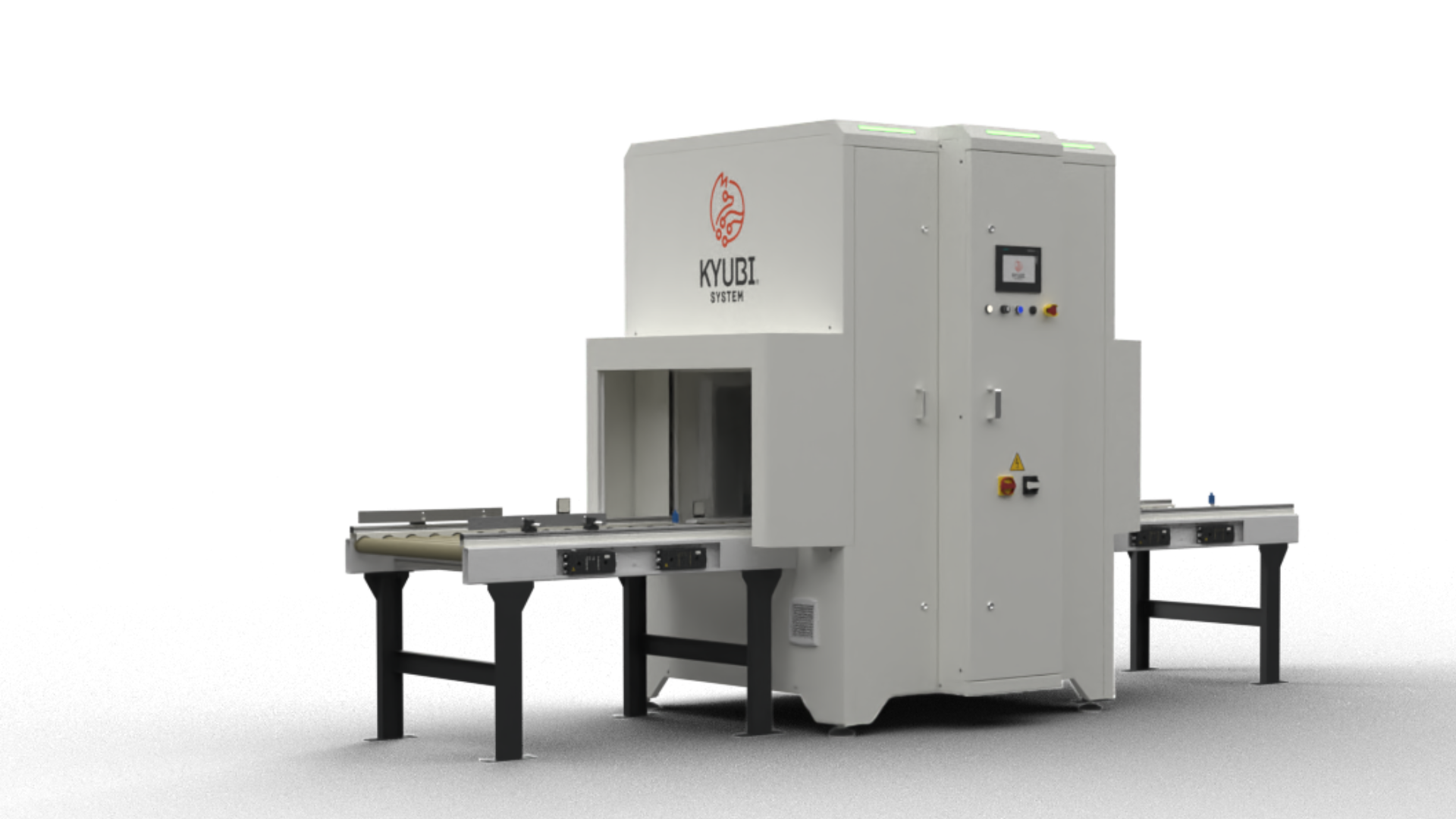
They can be fixed (portals, tunnels, checkpoints), portable (cyclic inventories) or embedded in machinery. The selection depends on the process: inventory, verification, WIP, asset tracking.
RFID antennas
Define coverage and stability. Linear vs. circular polarisation, gain, radiation pattern and distance to target determine read rate. In mass readout, antenna design is critical to reduce “RF shadowing”.
Software and middleware
The layer that transforms readings into actionable events. Examples of critical functions:
– De-duplication (repeated readings due to zone permanence)
– Rules per process (windows per order, per station, per dock)
– API integration with ERP/WMS/MES
– Traceability and auditing (who/when/where)
Kyubi differential: the value is multiplied when you combine hardware (tunnels/portals) + software (wAIM! and AIM) + integration. This avoids the “reader project” and turns it into an operational control system.
Frequencies: LF, HF, UHF and NFC.
| Band: | Range | Typical Range | Strengths | Typical Uses |
|---|---|---|---|---|
| LF | 125-134 kHz | cm | Robust to water/metal (as appropriate) | Animal identification, access |
| HF | 13.56 MHz | cm-1 m | Good for proximity | Cards, libraries, proximity processes |
| UHF | 860-960 MHz | 1-12 m | Mass reading + longer range | Inventory, logistics, retail, industry |
| NFC | 13.56 MHz | ~0-10 cm | Mobile interaction | Authentication, consumer engagement |
Standards: EPC Gen2, ISO 18000-63, RAIN and GS1
Standards ensure interoperability between tags/readers/software. In UHF, the standard for logistics and inventory is EPC Gen2 / ISO 18000-63, commonly associated with the RAIN RFID ecosystem. For global traceability, the identification layer is often aligned with GS1 data models (e.g. EPC-based serialisation).
Why it matters for your project
– Scalability: more providers supported, less lock-in.
– Integration: consistent data with ERP/WMS and traceability.
– Quality: best practices for mass reading and anti-collision.
Real RFID system architecture
Winning architecture is not about “putting readers in”: it is about designing a system that captures, debugs and translates reads into fully traceable business events.
Architecture: Tags → Antennas → Readers → Middleware (wAIM!/AIM) → APIs → ERP/WMS/MES → BI/Alerts → BI/Alerts
Architecture checklist (what decides if it works or not)
– Define events: what does “received”, “dispatched”, “in station”, “quarantined” mean.
– Read windows: time and conditions to validate (avoid phantom readings).
– Rules per process: per order, per batch, per station, per dock.
– Target rate: accuracy target (e.g. 99% shipping verification).
– Integration: endpoints, queues/events, reconciliation with data master.
Internal links (recommended)


RFID vs barcode
| Criteria | Barcode | RFID |
|---|---|---|
| Line of sight | Required | Not required |
| Bulk read | No | Yes (hundreds of tags) |
| Speed | Unit to unit | Automatic and simultaneous |
| Automation | Limited | High (events per step) |
| Cost per unit | Very low | Depends on tag/environment |
In modern operations, RFID for operational control and barcode as a backup or for processes where full automation does not pay off.
Use cases: retail, logistics, industry and pharma.
Retail: automatic inventory + loss prevention
Inventories in minutes, stock accuracy close to 98-99% and reduction of stock outs. Critical point portals detect unregistered outlets and improve operational control.
Logistics: automatic verification of dispatches
Tunnels/portals validate actual content vs. order in seconds. The software compares EPCs with the WMS order and triggers alerts if there are discrepancies.
Industry: WIP + asset tracking
Portals between stations or control points capture steps and update the status of work in progress (WIP). Improves planning, reduces searches and downtime.
Pharma: traceability + stock and batch control
EPC↔batch/caducity association, movement auditing, reduction of preparation errors and rapid traceability in the face of recalls.
Implementation: technical checklist + IT + operation.
Phase 1 – Discovery (1-2 weeks)
– Process map and reading points
– Event definition (reception/dispatch/WIP)
– Accuracy target and SLA
Phase 2 – PoC (2-4 weeks)
– Tag selection (includes on-metal if applicable)
– Antenna design and power
– Read rate and false readings validation
Phase 3 – Pilot (4-8 weeks)
– Integration with ERP/WMS/MES (APIs/Connectors)
– Business rules (windows per order/batch)
– Operational dashboards + alerts
Phase 4 – Deployment and operation
– Operational standards (labelling, locations, flows)
– Monitoring: read rate, latency, events
– Continuous improvement: RF tuning and software rules
Cost and ROI: how to estimate it
ROI usually comes from four levers: time savings (inventory/receiving/checking), reduced shipping errors, reduced losses and improved availability (more sales/less breakages). Estimation should be modelled by process.
| Lever | Metrics | How to monetise |
|---|---|---|
| Inventory | Hours → minutes | Labour cost + inventory frequency |
| Dispatch | % errors | Returns + penalties + reprocesses |
| Losses | Shrinkage | Margin recovered |
| Availability | OOS | Recovered sales (uplift) |
Recommendation: create an “ROI RFID calculator” as a lead magnet (downloadable). It is one of the highest converting assets for pillar content.
RFID Frequently Asked Questions
¿Qué es RFID y qué significa?
RFID significa Radio Frequency Identification. Es una tecnología para identificar y rastrear objetos mediante tags que se comunican por radio con lectores y antenas.
What is the scope of RFID?
It depends on the band and the environment. LF/HF operate at short range; UHF can reach several metres. Actual performance depends on tags, antennas, power and presence of metal/liquids.
¿RFID y NFC son lo mismo?
NFC es una forma de RFID en HF (13,56 MHz) orientada a distancias muy cortas y móviles. RFID UHF (RAIN) está optimizado para lectura masiva e inventario.
How does RFID integrate with ERP/WMS/MES?
Through APIs and event rules: EPCs are associated to items/order/batches and events are published in real time (reception, movement, dispatch, station). The middleware avoids duplicates and consolidates readings.
<p style=”font-size: initial; colour: #424242;”>
It depends on volumes, tag type, read points, software and integration. Cost should be modelled per process and compared to operational savings and error/loss reduction.
</p>
</details>
<div style=”text-align:centre;”>
<a href=”https://www.kyubisystem.com/consultoria/”
style=”
display:inline-flex;
align-items:center;
justify-content:center;
background-color:#fc4b08;
colour:#ffffffff;
padding:6px 16px;
font-size:14px;
font-weight:600;
text-decoration:none;
border-radius:5px;
line-height:1;
transition: all 0.2s ease;
”
onmouseover=”this.style.backgroundColor=’#e04306′; this.style.transform=’scale(1.03)’;”
onmouseout=”this.style.backgroundColor=’#fc4b08′; this.style.transform=’scale(1)’;”>
Request Specialised Technical Consultancy
</a>
</div>
<!– Schema: Article –>
<script type=”application/ld+json”>
{
“@context”: “https://schema.org”,
“@type”: “Article”,
“headline”: “RFID: What it is, how it works and how to implement RFID systems (Complete Guide)”,
“description”: “Complete guide to RFID: definition, operation, components, frequencies (LF/HF/UHF), standards (EPC Gen2/RAIN), architecture, use cases, implementation and ROI,
“author”:{“@type”: “Organisation”, “name”: “Kyubi System”},
“publisher”:{
“@type”: “Organisation”,
“name”: “Kyubi System”,
“logo”:{“@type”: “ImageObject”, “url”: “https://www.kyubisystem.com/wp-content/uploads/logo-kyubi.png”}
},
“mainEntityOfPage”:{“@type”: “WebPage”,”@id”: “https://www.kyubisystem.com/blog/rfid-guia-completa/”},
“datePublished”:”2026-03-05″,
“dateModified”:”2026-03-05″,
“image”: “https://www.kyubisystem.com/wp-content/uploads/rfid-guia-completa.jpg”,
“inLanguage”: “en”
}
</script>
<!– Schema: Breadcrumb –>
<script type=”application/ld+json”>
{
“@context”: “https://schema.org”,
“@type”: “BreadcrumbList”,
“itemListElement”:[
{“@type”: “ListItem”, “position”:1, “name”: “Home”, “item”: “https://www.kyubisystem.com/”},
{“@type”: “ListItem”, “position”:2, “name”: “Blog”, “item”: “https://www.kyubisystem.com/blog/”},
{“@type”: “ListItem”, “position”:3, “name”: “RFID”, “item”: “https://www.kyubisystem.com/blog/rfid-guia-completa/”}
]
}
</script>
<!– Schema: FAQ (adjusts answers if you change visible text) –>
<script type=”application/ld+json”>
{
“@context”: “https://schema.org”,
“@type”: “FAQPage”,
“mainEntity”:[
{
“@type”: “Question”,
“name”: “What is RFID?”,
“acceptedAnswer”:{“@type”: “Answer”, “text”: “RFID (Radio Frequency Identification) is an automatic identification technology that uses radio waves to read and record electronic tags associated with products or assets, without the need for direct line-of-sight.”}
},
{
“@type”: “Question”,
“name”: “How does an RFID system work?”,
“acceptedAnswer”:{“@type”: “Answer”, “text”: “A reader emits radio frequency through an antenna, activates tags within its range and receives their identifier (e.g. EPC). The software filters readings, generates events and integrates them with ERP/WMS/MES.”}, “text”:”{“@type”: “answer”, “text”:”}
},
{
“@type”: “Question”,
“name”: “Which RFID frequency is most commonly used in logistics and inventory?”,
“acceptedAnswer”:{“@type”: “Answer”, “text”: “In logistics, inventory and mass-reading the most common band is UHF (860-960 MHz), typically under standards such as EPC Gen2 / ISO 18000-63 (RAIN RFID).”}
},
{
}, { “@type”: “Question”,
“name”: “Does RFID replace barcode?”,
“acceptedAnswer”:{“@type”: “Answer”, “text”: “Not always. RFID is superior for mass reading and automation, but barcodes are still useful for cost and simplicity. In many operations, RFID for operational control and barcode as redundancy or backup coexist.”}, “text”:”}, “text”: “text”: “text”.
},
{
“@type”: “Question”,
“name”: “What is the typical ROI of an RFID project?”,
“acceptedAnswer”:{“@type”: “Answer”, “text”: “It depends on the use case and volume. The ROI usually comes from reduced inventory times, reduced shipping errors, reduced losses and improved availability. In well sized projects the payback is usually between 12 and 24 months.”}
}
]
}
</script>